
1. What is GPU infrastructure?
GPU infrastructure, a container-based distributed computing platform centered on GPUs, is an integrated computing environment composed of GPU resources, compute nodes, networks, storage, orchestration, and a software stack, built to perform large-scale parallel computation (AI training, deep learning, HPC, and so on) that is difficult to process on a CPU-based system.
2. How does GPU infrastructure differ from general IT infrastructure?
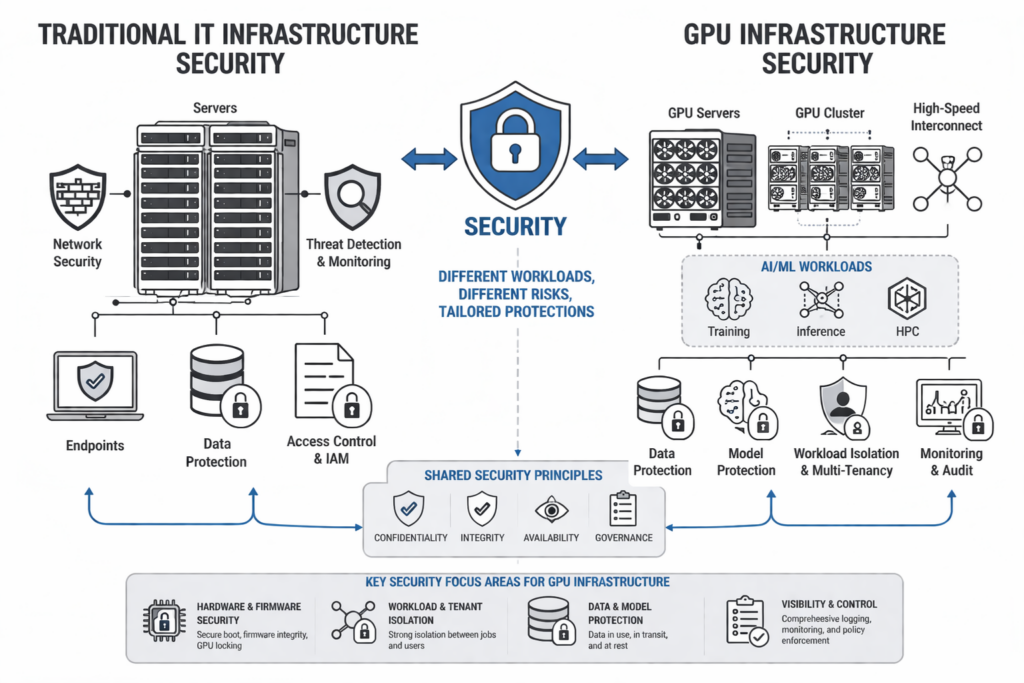
GPU infrastructure is not simply server infrastructure. It is a structure that combines container-based distributed computation, data and model processing, and a multi-tenancy environment, so it differs in the structure of core assets, the mode of operation, the method of isolation, and the attack surface.
GPU infrastructure security must therefore shift from a server-centered view to a view centered on Workload, Data, and Orchestration.
| Category | General IT Infrastructure | GPU Infrastructure |
| Core Assets | Servers, DBMS, Application | Data, Model, GPU Workload |
| Execution Structure | VMs, physical servers | Container, Kubernetes , GPU plugin |
| Users | Use of fixed service accounts | Dynamic users (ML engineers, job-based execution, and so on) |
| Network Structure | North-South centered | East-West (inside the cluster) centered |
| Data Flow | DB-centered | Large-scale dataset movement, model creation and replication |
| Isolation Method | Network, VM | Pod/container isolation |
| Operating Model | Static services | Dynamic jobs (frequent creation and deletion) |
| Attack Surface | Servers, web, databases | Container, API, GPU runtime, Model |
3. How does GPU infrastructure security differ from general IT infrastructure security?
- (Server security -> workload-security centered) GPU infrastructure
is a structure in which container-based jobs are continually created and deleted, so the execution environment and permission control of each workload (pod/container) matter more than the individual server. Server hardening alone is not enough, and a security policy at the pod level is essential. - (Network perimeter -> internal-traffic centered) GPU infrastructure
consists mostly of communication between internal pods, so control of internal east-west traffic and fine-grained access control through zero-trust microsegmentation matter more than perimeter security such as the network firewalls of existing IT infrastructure. - (VM isolation -> container isolation) GPU infrastructure
is operated on a container-based structure and shares the kernel, so attack risks such as Escape to Host, permission settings, and access to host resources become important issues. Fine-grained security settings at the container level are therefore essential. - (Fixed accounts -> dynamic Token/ServiceAccount) GPU infrastructure
makes dynamically created and used credentials, such as the Kubernetes ServiceAccount and the API token, the core means of authentication. Credential management is therefore highly important in order to prevent takeover of the entire system through token theft, Kuberconfig leakage, and similar events. - (DB-centered -> data, model, and artifact centered) CPU infrastructure
must treat not only the data of existing IT infrastructure but also datasets, trained models, embeddings, Check Points, and similar items as important assets, so a protection strategy is required for AI assets as a whole, covering data leakage as well as model theft, reuse, and replication. - (Application supply chain -> AI/ML supply chain) GPU infrastructure
has a composite supply-chain structure that combines container images, the CUDA environment, external models, training data, scripts, and other elements, in addition to supply-chain management centered on application code and libraries in existing IT infrastructure. Supply-chain integrity verification that includes models and data, going beyond simple code verification, therefore becomes an essential security element.
4. Top 10 Design Principles for GPU Infrastructure Security
- (Workload-centered security) GPU infrastructure
is centered on container-based workloads rather than on servers, so security controls must also be enforced at the pod/container execution unit rather than at the server unit. Every workload must receive a security policy at execution time, and execution itself must be blocked when the image, permissions, and network access have not been verified in advance. - (East-West-based Zero Trust) GPU infrastructure
has a high proportion of internal communication, so the network inside the cluster must also be designed as an untrusted structure. All communication between services must be allowed on the basis of explicit authentication and authorization, and network policy segmented by namespace and by service must be applied. - (Strengthened container isolation) A container
shares the kernel, so isolation can be weak. Privileged mode, access to host resources, and execution as root must therefore be minimized, and isolation technologies such as seccomp and AppArmor/SELinux must be applied by default in order to block the risk of container escape structurally. - (Management based on a dynamic credential lifecycle) GPU infrastructure
uses token-based authentication more than static accounts, so every credential must have a short lifetime and least privilege, and the issuance, use, and revocation of ServiceAccounts, API tokens, and kubeconfig must be controlled across the full lifecycle. Credentials must be managed by injection at runtime rather than by storage. - (An integrated protection system for AI assets such as data and models) In GPU infrastructure,
not only data but also models, checkpoints, embeddings, and similar items are important assets, so every AI asset must be protected at the same level. It must be possible to track and control not only data access but also model replication, download, and reuse. - (AI supply-chain integrity) GPU infrastructure
has a composite supply chain made up of many elements, including code as well as images, libraries, CUDA, models, and data. Every component must therefore be used only after its origin is verified and its integrity is confirmed, and only through an approved path, and an untrusted external artifact must be blocked before execution. - (Management of access control for GPU resources) A GPU
is an expensive core resource, so not every workload should be left able to use a GPU. GPU resources must be allocated only to approved users, namespaces, and workloads, and unauthorized use or abnormal occupation of resources must be detectable. - (Multi-tenancy isolation) GPU infrastructure
is an environment shared by multiple users and teams, so data, workloads, and resources must be separated between different tenants. Logical and physical isolation must be applied on the basis of namespace, storage, GPU resources, and the network, and residual data must not remain after a job ends. - (Visibility and detection of anomalous behavior) GPU infrastructure
is a dynamic environment, so visibility that can trace every action is essential. Events such as the Kubernetes API, container execution, GPU usage, data access, and permission changes must be collected, and abnormal behavior patterns must be detectable in real time. - (Operation centered on an assume-breach and rebuild approach) GPU infrastructure
has a complex and dynamic structure, so completely preventing a compromise is difficult. It must therefore be designed on the assumption of compromise, and a node on which a problem has occurred must be operated by isolating it and then redeploying it (reprovisioning) rather than by repairing it. An automated recovery system and rebuilds based on a standard image are required for this.