
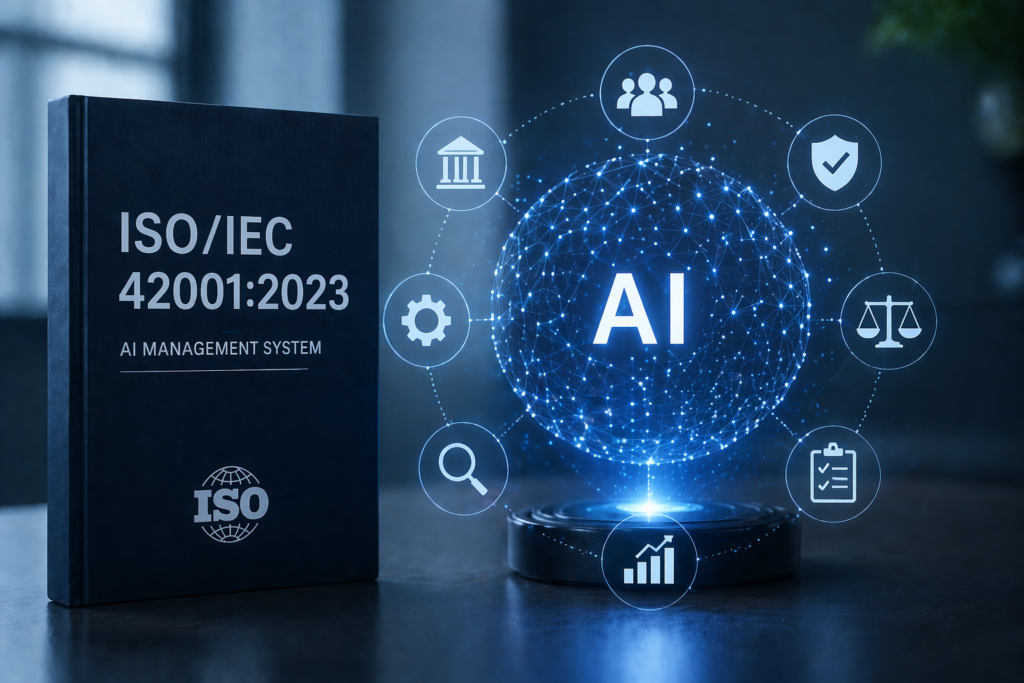
Overview of ISO/IEC 42001:2023
ISO/IEC 42001:2023 is an international standard defining requirements for organizations to develop, operate, and manage Artificial Intelligence (AI) systems responsibly and safely. While the existing ISO/IEC 27001 provides a management system focused on information security, ISO/IEC 42001 presents an Integrated Management System (AIMS) that reflects unique AI characteristics, including ethics, safety, transparency, and accountability.
In Korea, the environment is rapidly shifting toward mandatory AI risk management and accountability due to the enactment of the “AI Basic Act” and the release of Financial Sector AI Guidelines. In this landscape, ISO/IEC 42001 certification is the most realistic and systematic approach for organizations to meet legal and regulatory requirements while building an AI management system aligned with global standards.
Necessity of ISO/IEC 42001 Certification
1. Essential Management System for AI Basic Act Compliance
The draft Korean AI Basic Act requires AI providers to ensure safety, manage risks, and maintain transparency. Key requirements include:
- Mandatory identification and assessment of AI system risks.
- Establishment of safety assurance and incident response systems.
- Ensuring user protection and explainability.
ISO/IEC 42001 provides a structure that directly reflects these needs, serving as a practical framework for legal compliance.
2. Response to Financial Sector AI Guidelines
The financial sector already demands specific control requirements for AI utilization:
- Ensuring explainability and verifiability of AI models.
- Managing data bias and fairness.
- Model Risk Management (MRM).
- Ensuring internal controls and auditability.
This transcends simple IT control, requiring AI Lifecycle Governance. ISO/IEC 42001 aligns directly with financial requirements in areas such as:
- Data management and quality control.
- Model development, validation, and operational control.
- Transparency in AI decision-making.
- Stakeholder communication and accountability.
Financial organizations can simultaneously achieve regulatory compliance and strengthened internal controls through this certification.
3. Addressing Structurally Increasing AI Risks
Unlike traditional IT systems, AI systems possess unique risks:
- Data Bias: Discrimination and regulatory risks.
- Model Errors: Financial and decision-making failures.
- Black Box Structure: Unclear accountability.
- Expanded Automation: Increased scope of impact in case of accidents.
ISO/IEC 42001 provides a structure to manage these risks through proactive controls.
Expected Benefits of ISO/IEC 42001 Certification
1) Proactive Establishment of Regulatory Response Systems
By pre-reflecting the AI Basic Act and financial regulations, organizations can build a preemptive compliance system rather than a reactive one.
- Reduction of regulatory risks.
- Improved efficiency in audit and supervisory response.
2) Ensuring AI Trustworthiness and Strengthening Customer Protection
Reliability of AI outputs is critical in financial and public services. ISO/IEC 42001 enables:
- Management of AI decision-making evidence.
- Securing explainability.
- Minimizing impact on users.
This leads to enhanced customer trust and service quality.
3) Advanced Internal Control and Model Risk Management
Standard-based implementation of model risk management ensures a stable foundation for AI services.
- Systematization of model validation processes.
- Ensuring change management and traceability.
- Strengthened audit readiness.
4) Securing Global and External Credibility
As an internationally recognized standard, the certification plays a vital role in:
- Securing global partnerships.
- Strengthening the foundation for overseas business expansion.
- Responding to ESG and Responsible AI requirements.
5) Management Innovation based on AI Governance
Beyond a mere certificate, ISO/IEC 42001 is a tool to upgrade the overall AI utilization level, promoting a transition to an AI-based Management System (AIMS).
- Integration of AI strategy and risk management.
- Clarification of roles and responsibilities within the organization.
- Establishment of a data/model-centric operating system.
Conclusion
ISO/IEC 42001 certification is a key strategic tool to achieve:
- Compliance with the AI Basic Act and financial regulations.
- Establishment of an AI risk management system.
- Provision of trust-based AI services.
- Securing global competitiveness.
Therefore, it is crucial for organizations to take a step-by-step approach—from assessing current AI utilization to defining target levels, designing controls, and building the operational system.
(*) ISO/IEC 42001:2023 Annex A – Summary of Reference Control Objectives and Controls